A graphing calculator built for classrooms, needing teachers to try it and schools to adopt it, on a budget most agencies would call a rounding error.
K-12 EdTech
Paid social, Influencer program management, Campaign measurement, ROI analysis
Campaign engagement, six months
The challenge
The buying motion here runs twice. A teacher has to try the calculator, and then a school has to adopt it. A campaign that only earns attention has done half a job.
NumWorks was also paying four creator partnerships alongside its paid social, and nobody could say which of the five channels was producing schools rather than traffic. Everything was being judged on reach.
What we did
Built and ran the paid social program end to end, aimed at educators rather than consumers, with creative built around classroom usability instead of specifications.
Fed offline conversions back into the platform, so it optimized toward teacher signups and school adoptions rather than cheap clicks. This is the step most programs skip, and it is the one that changes what the algorithm chases.
Put all five channels on one scoreboard, cost per qualified lead and cost per new school side by side, so the budget conversation became arithmetic instead of opinion.
Tested format deliberately, video against carousel against single image, and moved budget toward what converted rather than what looked good.
Every channel started with a brief
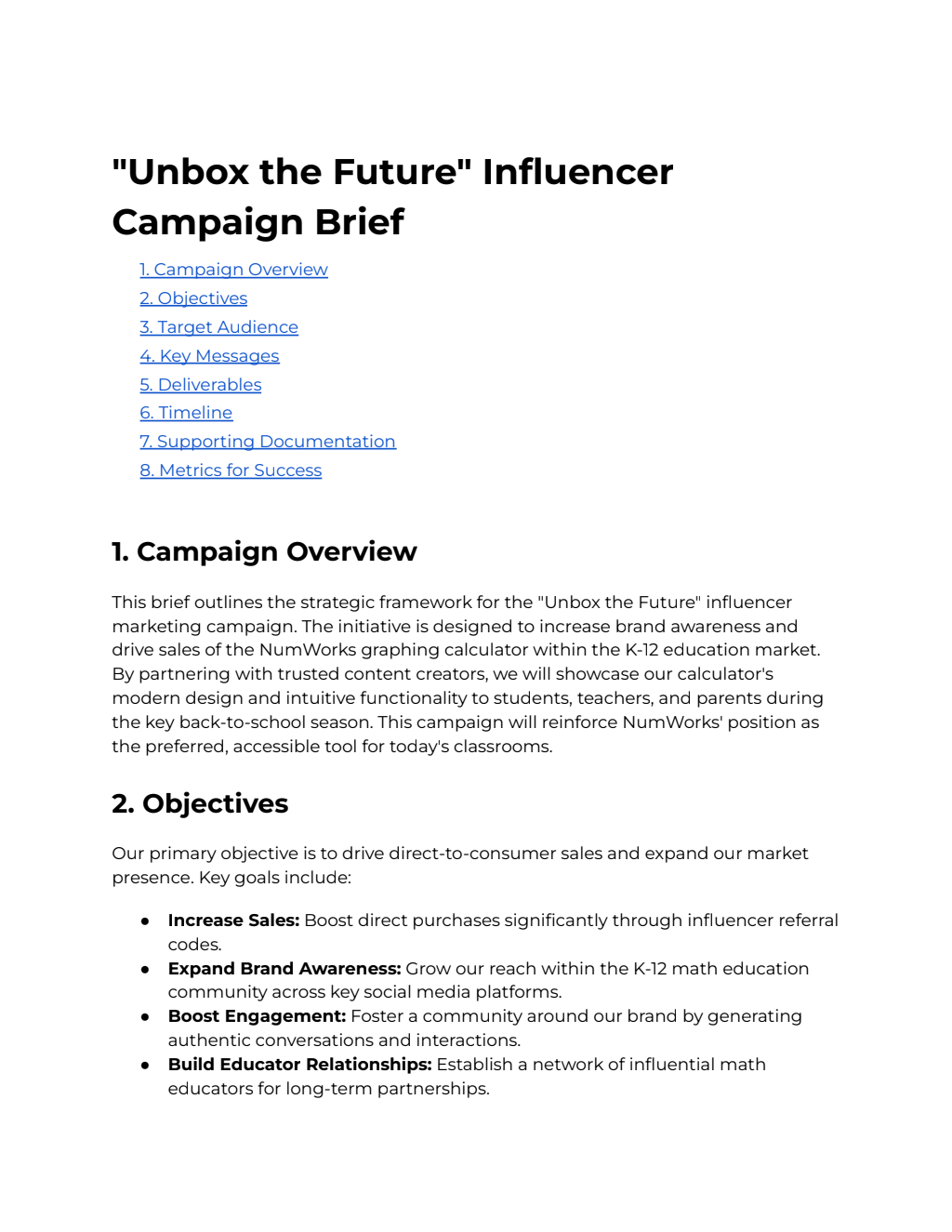
Two campaigns, two briefs, one objective. Nothing went into market on a verbal.
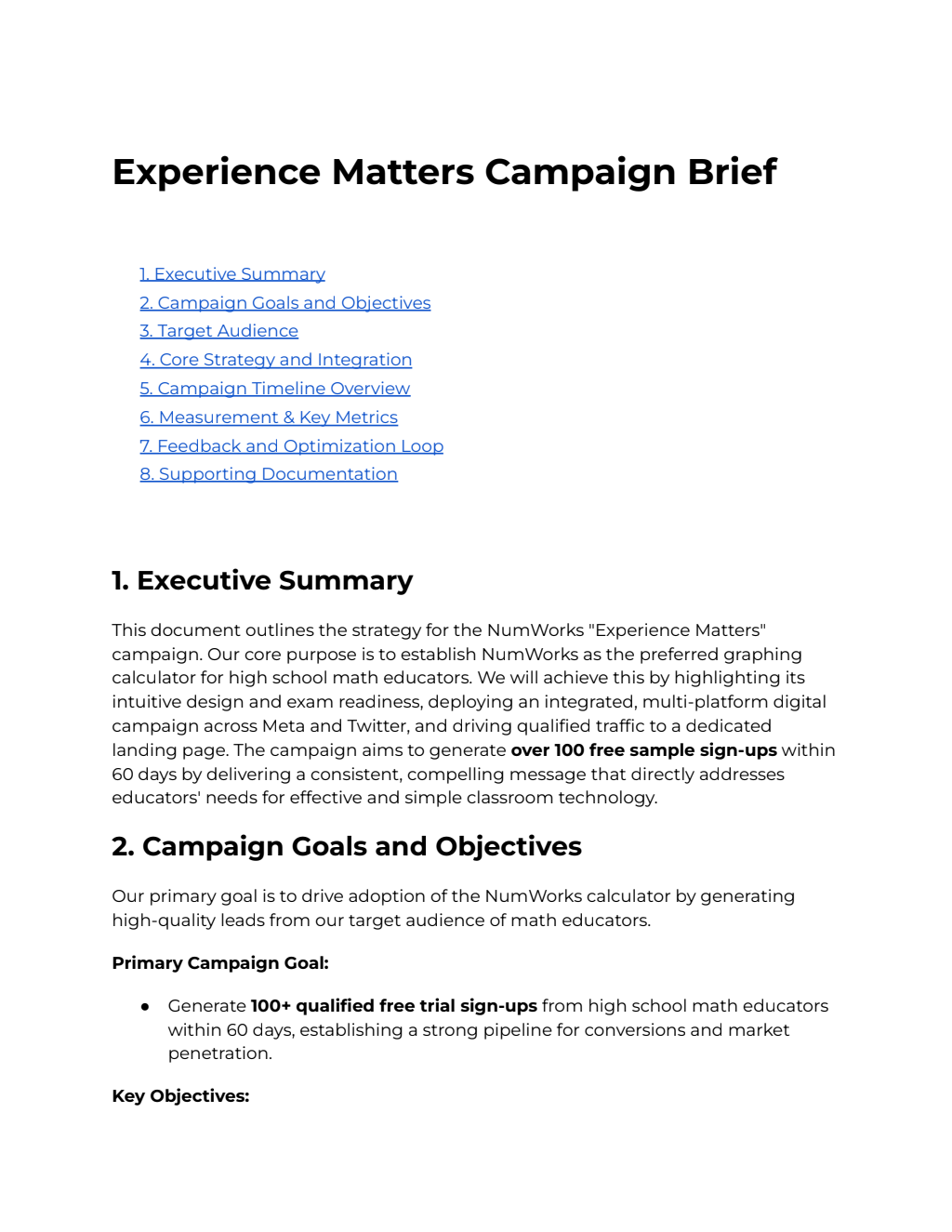
Experience Matters, the paid social campaign brief
Unbox the Future, the creator campaign brief
The creator program, run as a channel
Most influencer work is a handshake and a hope. This was operated like any other media line.
Four math and STEM creators under contract, publishing to YouTube, TikTok and Instagram, each briefed against the same campaign objective rather than left to improvise.
The whole operational spine sat with us: creative briefs, contract terms, bonus structures, draft review and approval, publishing schedules, tracked links, and invoicing through to payment.
Every creator carried its own tracking, so each partnership could be judged on qualified leads and schools rather than on views.
We held the line on quality. One creator reshot a video unprompted to sharpen the hook and show the product properly. That only happens when the brief is clear and the relationship is managed.
The comparison that came out of it was the point. The strongest creator matched paid social almost exactly on cost per qualified lead. Two others were producing schools at fifteen to twenty times the cost of the best channel, which is invisible until every partnership is measured the same way.
Results
21 new schools signed up at $86 each, from $1,815 in paid social spend.
153 teacher conversions at $11.86 each, and 230 form completions at $7.89.
2.71% click through rate at $0.17 CPC across 396,000 impressions, with frequency held at 1.28x and no fatigue across a six month flight.
The measurement work paid for itself. Paid social was producing roughly 70% of all new schools on 21% of total program spend, while two creator partnerships were costing $1,500 and $1,800 per school. That comparison redirected the budget.